Group of up to 8
Lanes and arcades tour
Most reviewed
- Length3 hours
- IncludesChocolate and coffee
- MeetsFederation Square
Guides
Language
Currency
Find open dates$90 and up · free cancelSpot your stop
Summary
The lanes and arcades of Melbourne centre on the Royal Arcade, Australia's oldest surviving arcade, and the Block Arcade with its mosaic floor, both between Collins Street and Bourke Street.
Arcade essentials
Open 54 stops
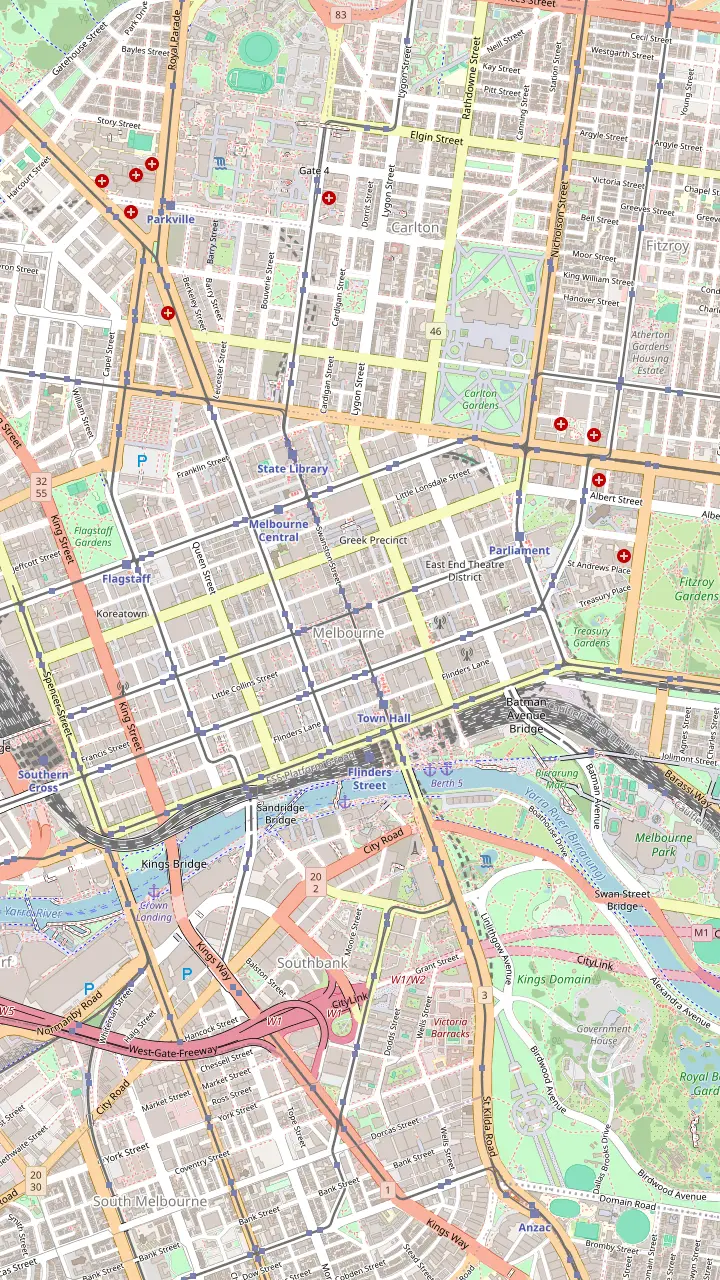
Tap a route first, then a pin or stop, for its note and Google Maps.
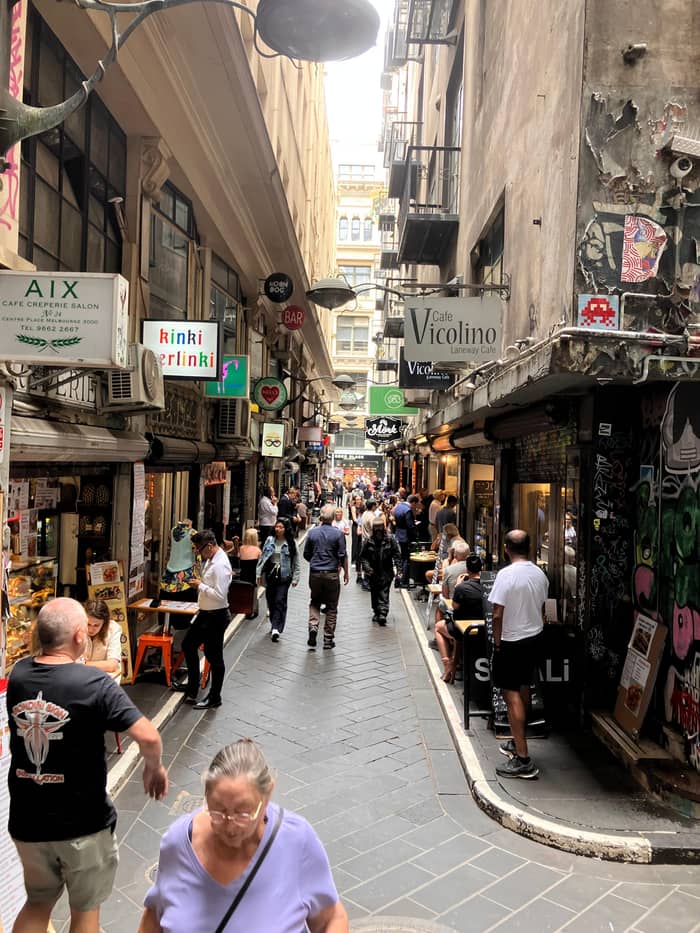
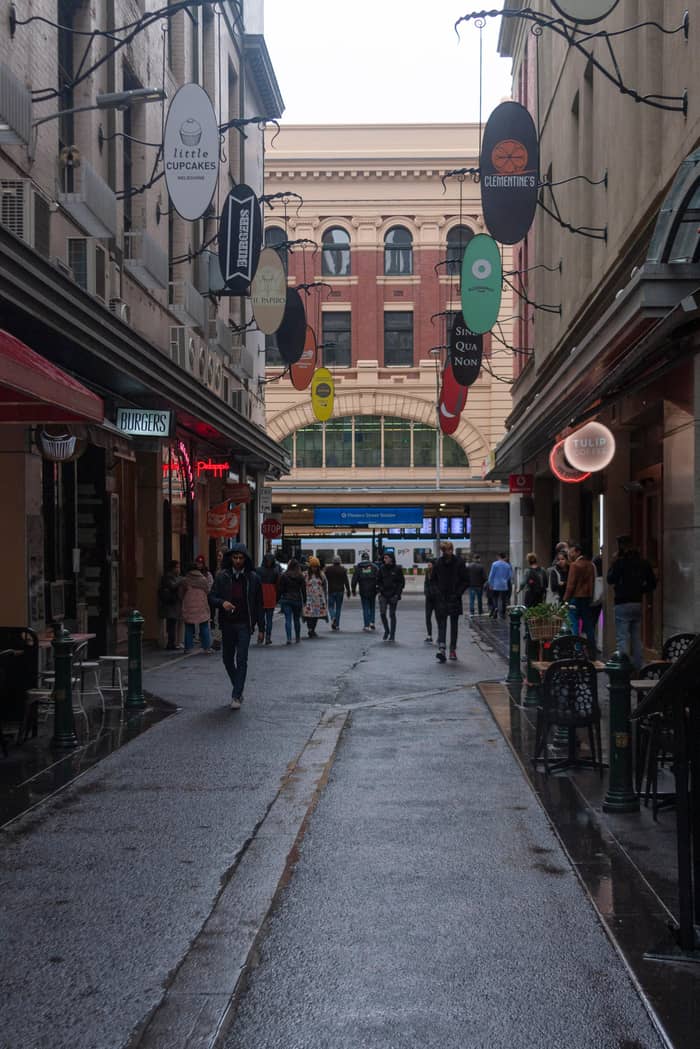
Opposite Flinders Street Station: brunch tables down the middle of the lane, street art, and small shops such as a Florentine stationer.
Google MapsA narrow, crowded alley of cafes and bars; note the Spanish Moorish Majorca Building on the corner, from 1928.
Google MapsThe lane behind the Block Arcade; its line is the reason the arcade bends.
Google MapsNamed after the fabric factories of the 1860s, now small designer and shoe shops.
Google MapsThe old rag-trade lane, with the Nicholas Building at its Swanston Street end.
Google MapsThe city's best-known street art lane, repainted so often that pieces vanish overnight.
Google MapsAustralia's first street named after a rock band, with a lightning bolt instead of the slash.
Google MapsHome of the bar that started the laneway revival, with Mike Makatron's Jungle Funk mural at the entry.
Google MapsA long lane of outdoor tables and live music; Kirk's recalls its 1840s horse trading.
Google MapsA rare survivor of the industrial city, now green with plants and cafes.
Google Maps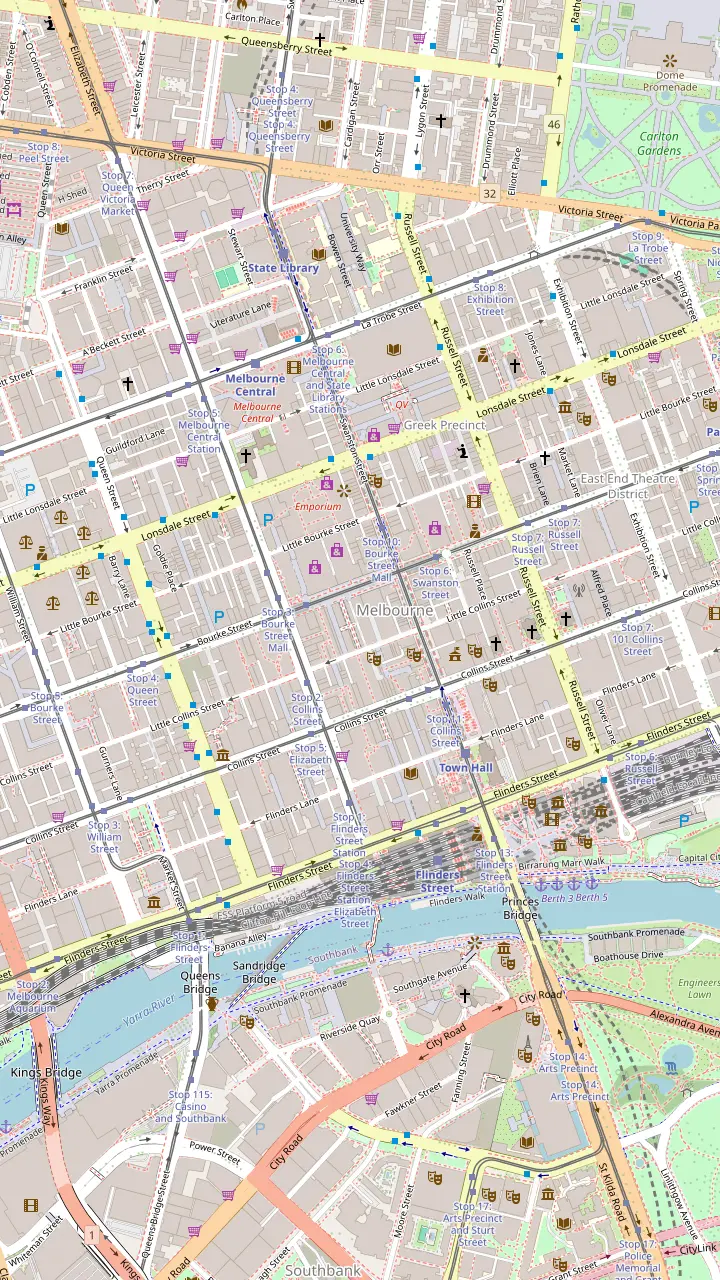
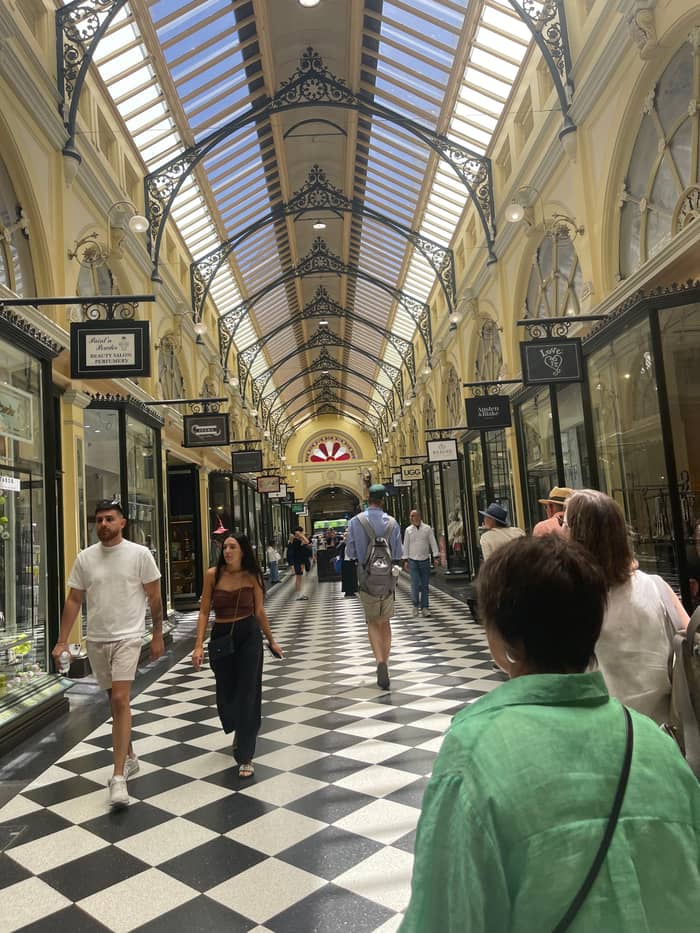
Glass roof and a mosaic floor laid with tiles from Europe; the Collins Street side was finished in February 1892.
Google MapsAustralia's oldest surviving arcade, built in 1869; Gog and Magog have struck the hours since 1892.
Google MapsEdwardian Baroque of 1911 linking Collins Street and Flinders Lane.
Google MapsAn Art Deco arcade that opens into the Nicholas Building of 1926.
Google MapsA 1924 cinema with lit ceilings by Walter Burley Griffin and Marion Mahony Griffin.
Google MapsArt Deco of 1932 and Melbourne's first building with escalators; mosaic arcade at street level.
Google MapsThe lane that leads to Presgrave Place, with a tiny vegan jaffle kiosk.
Google MapsA rainbow-lit arcade with a direct way into Emporium and the GPO.
Google MapsThe lane behind the Block Arcade; its line is the reason the arcade bends.
Google Maps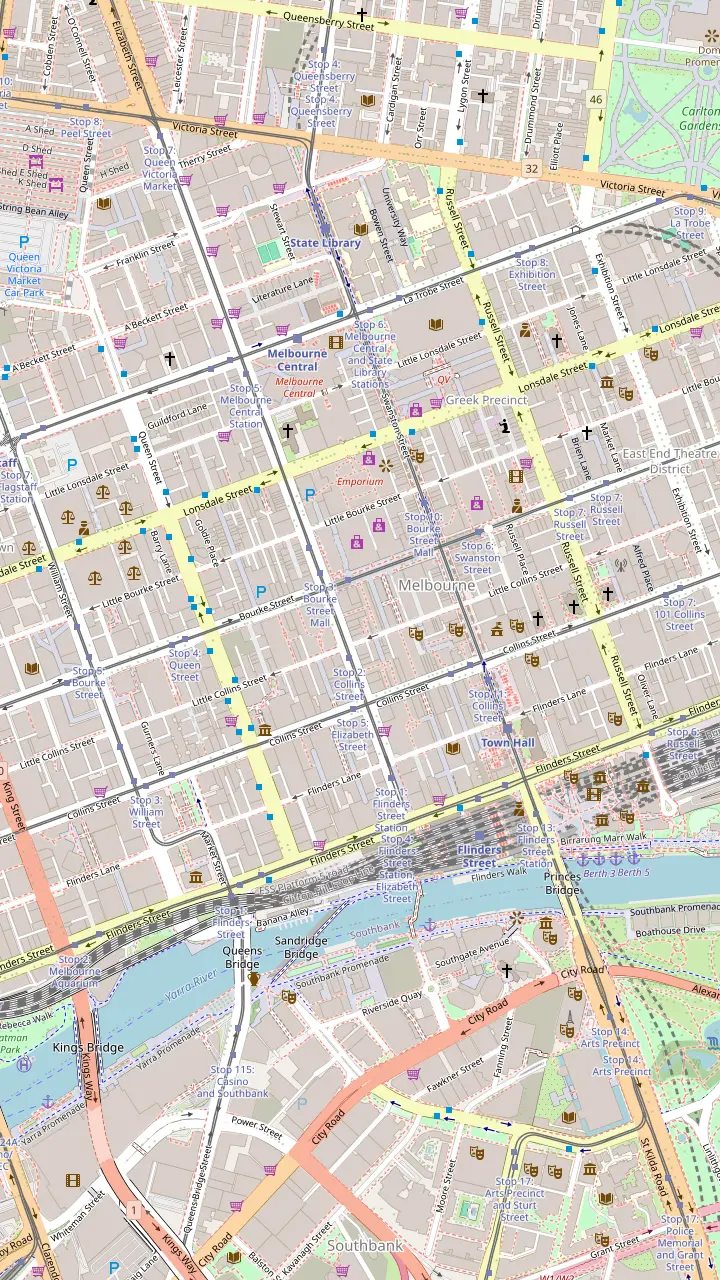
Opposite Flinders Street Station: brunch tables down the middle of the lane, street art, and small shops such as a Florentine stationer.
Google MapsA narrow, crowded alley of cafes and bars; note the Spanish Moorish Majorca Building on the corner, from 1928.
Google MapsCrepes and banh mi, and a look up at Bible House of 1898.
Google MapsAn Art Deco arcade that opens into the Nicholas Building of 1926.
Google MapsNamed after the fabric factories of the 1860s, now small designer and shoe shops.
Google MapsGlass roof and a mosaic floor laid with tiles from Europe; the Collins Street side was finished in February 1892.
Google MapsAustralia's oldest surviving arcade, built in 1869; Gog and Magog have struck the hours since 1892.
Google MapsA long lane of outdoor tables and live music; Kirk's recalls its 1840s horse trading.
Google MapsStreet art below, a piano bar upstairs.
Google MapsA double-storey shipping container bar with a rooftop.
Google MapsArtist Mirka Mora once worked here; today the balconies spill greenery.
Google MapsCoffee roasters and a shop for shoes, haircuts and suits.
Google MapsA rainbow-lit arcade with a direct way into Emporium and the GPO.
Google MapsFashion, cake and a basement bar under the lane.
Google MapsA green wall leads to a lantern-lit pizzeria; Emporium's floors of shops are at the far end.
Google Maps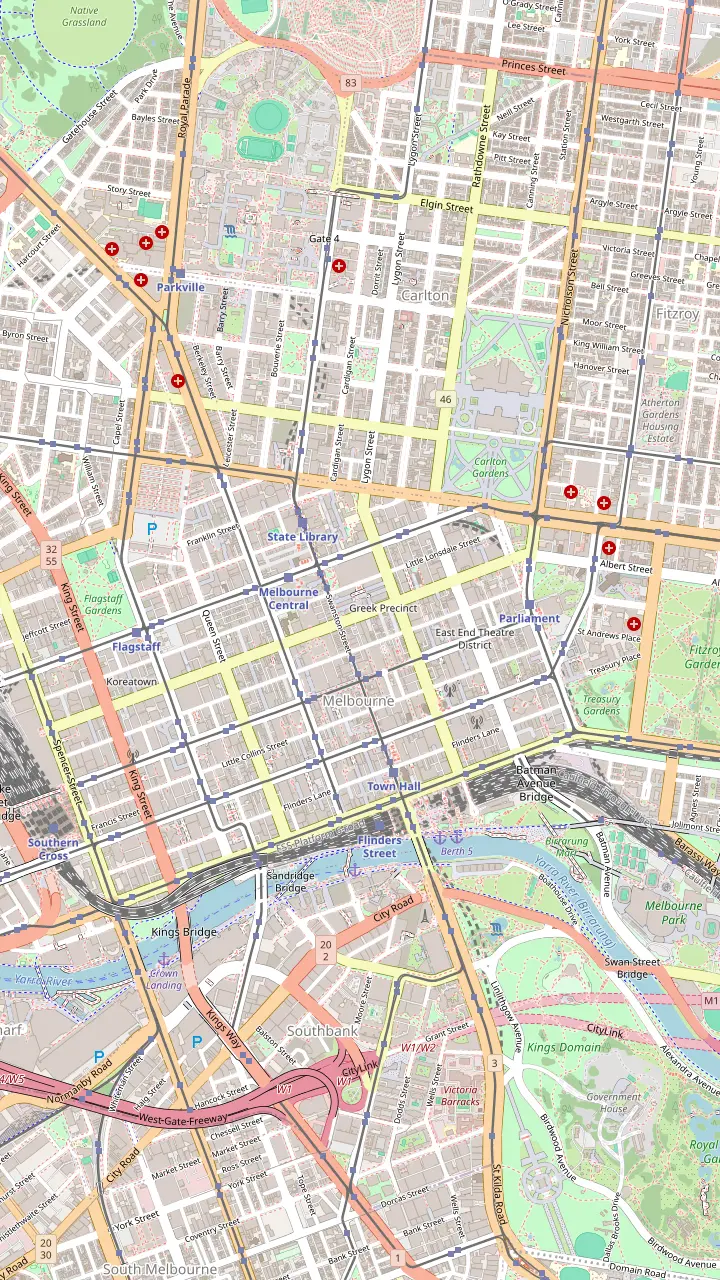
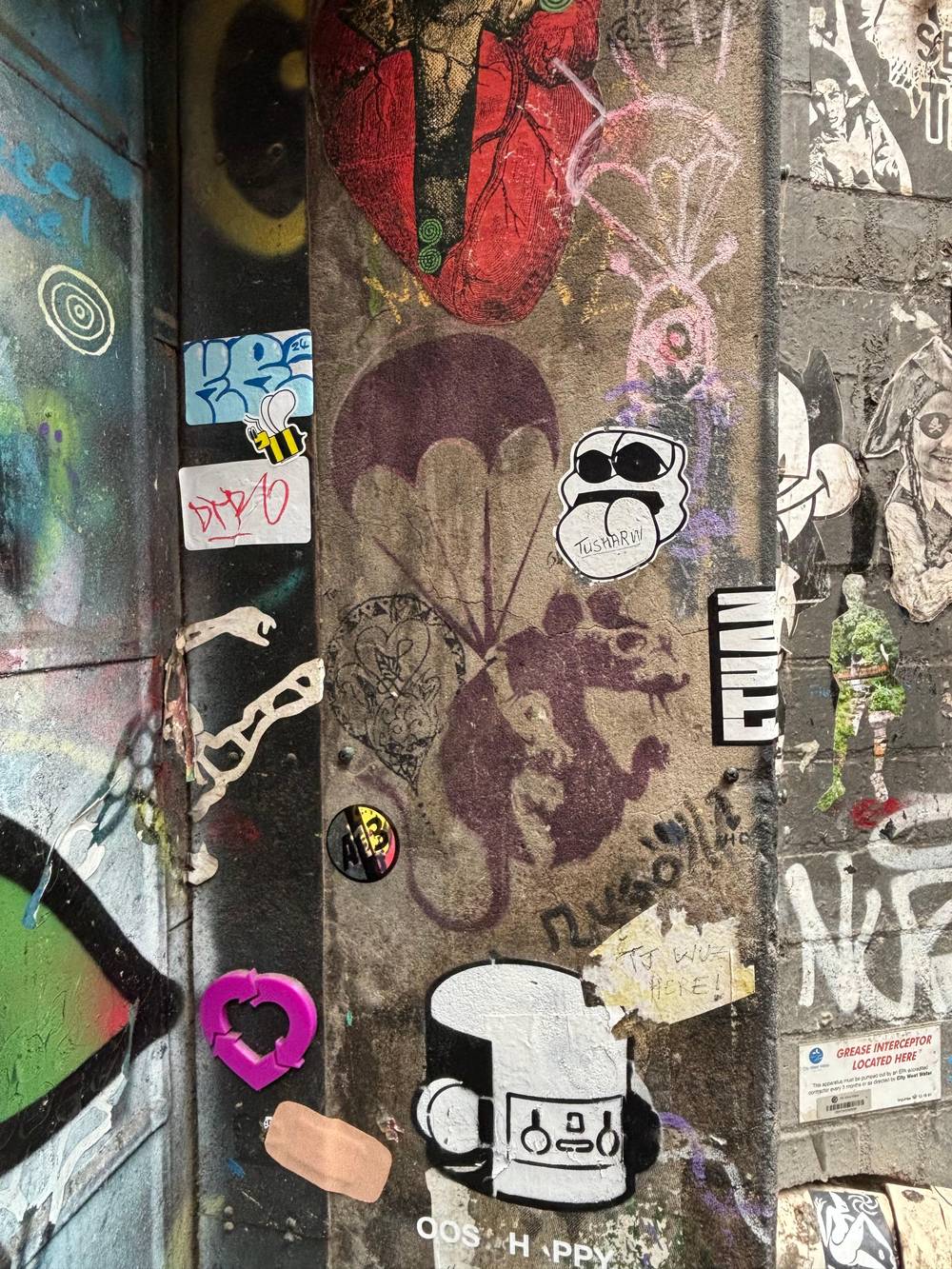
The city's best-known street art lane, repainted so often that pieces vanish overnight.
Google MapsOff Hosier Lane; even the bins here are painted over.
Google MapsAustralia's first street named after a rock band, with a lightning bolt instead of the slash.
Google MapsBig murals by Fintan Magee and Steen Jones, and one of the last Banksy rats.
Google MapsLisa King's giant sleeping woman on the wall of Brunetti.
Google MapsA miniature outdoor gallery of framed works on the walls.
Google MapsAbove the lane, a feathered portrait by Adnate and Shida from 2012; the container bar Section 8 below.
Google MapsA winding lane off Little Bourke Street with colourful murals.
Google MapsA tiled mosaic for Legacy House and a towering mural by Jaz Mishap at the end of the alley.
Google MapsNamed after Blender Studios, an early home of the city's street art scene, off Franklin Street.
Google MapsHome of the bar that started the laneway revival, with Mike Makatron's Jungle Funk mural at the entry.
Google Maps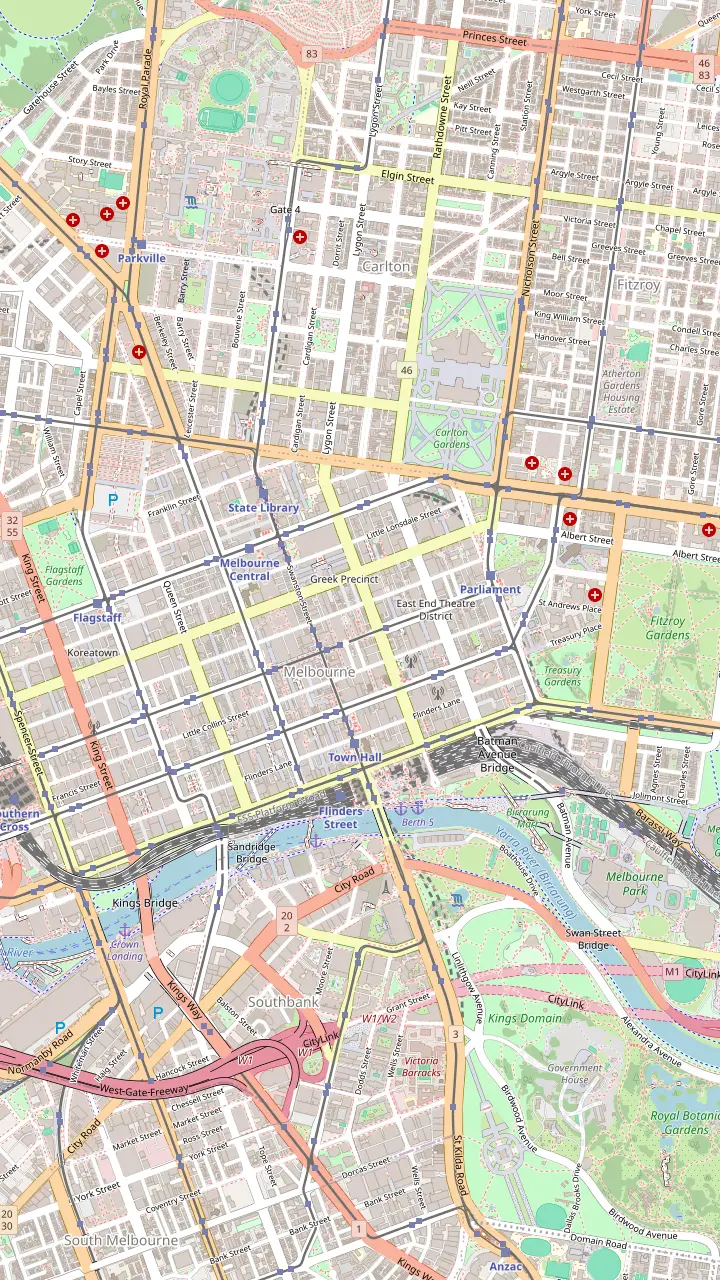
Australia's oldest train station site; the present building was completed in 1910. Meet under the clocks.
Google MapsA hotel built in 1861, before the station across the road.
Google MapsCompleted in 1870 in bluestone and Tasmanian freestone; free tours are offered.
Google MapsAustralia's oldest surviving arcade, built in 1869; Gog and Magog have struck the hours since 1892.
Google MapsGlass roof and a mosaic floor laid with tiles from Europe; the Collins Street side was finished in February 1892.
Google MapsListed as the oldest building in Melbourne, in a lane off Collins Street.
Google MapsOpened in 1854; Ned Kelly's armour is on display.
Google MapsMelbourne's prison from 1845, run today by the National Trust.
Google MapsIts exhibition traces how the city boomed after the 1850s gold finds.
Google MapsArt Deco of 1932 and Melbourne's first building with escalators; mosaic arcade at street level.
Google Maps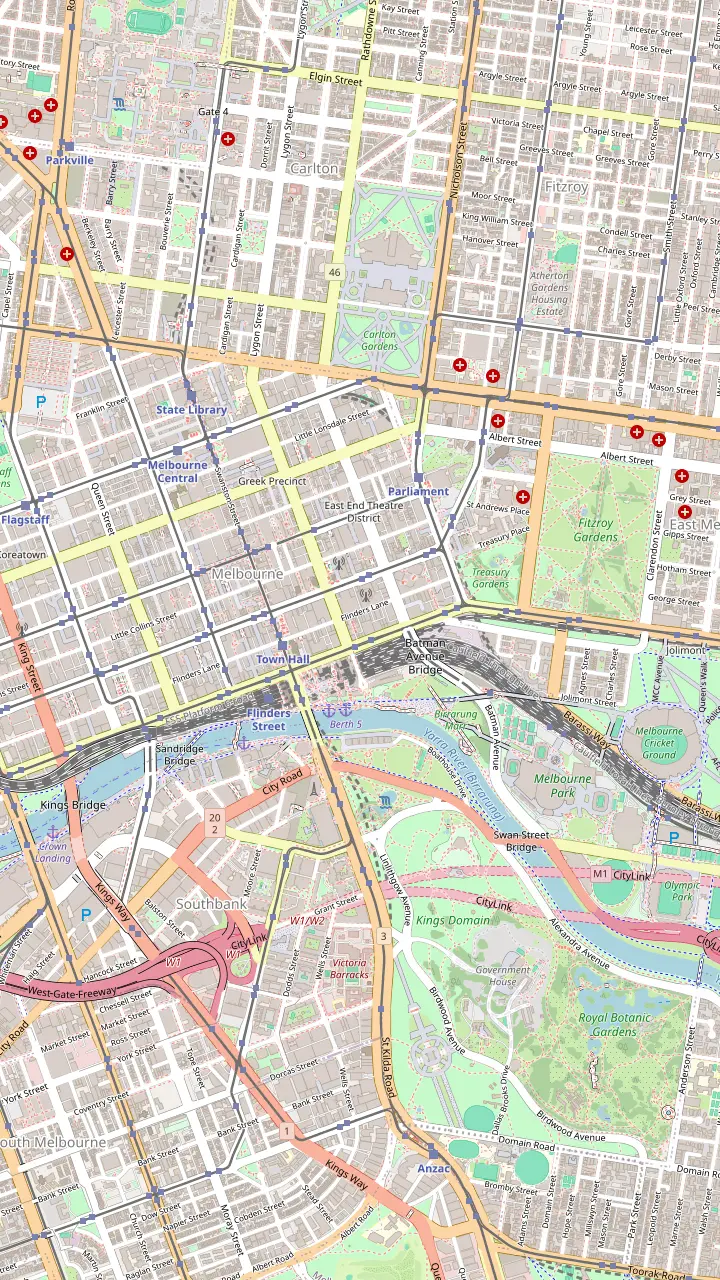
A First Peoples arts centre founded in 1985, open daily from 10am.
Google MapsThe river camp installation: an eel path, message sticks and ancestor stones by the river.
Google MapsNamed after a Wurundjeri elder; voices play as you walk across.
Google MapsWhere people gathered from the 1890s to the 1960s to hear Aboriginal speakers.
Google MapsA traditional Kulin meeting place; a paving inlay reproduces a William Barak painting.
Google MapsA 31-storey building whose balconies form a portrait of William Barak.
Google MapsIndigenous art from the NGV collection at Federation Square.
Google MapsMeet at the Visitor Centre for the First Peoples-led plant walk, 10:45am on Tuesday, Wednesday, Thursday, Saturday and Sunday.
Google MapsBunjilaka, the place of Bunjil, inside Melbourne Museum.
Google Maps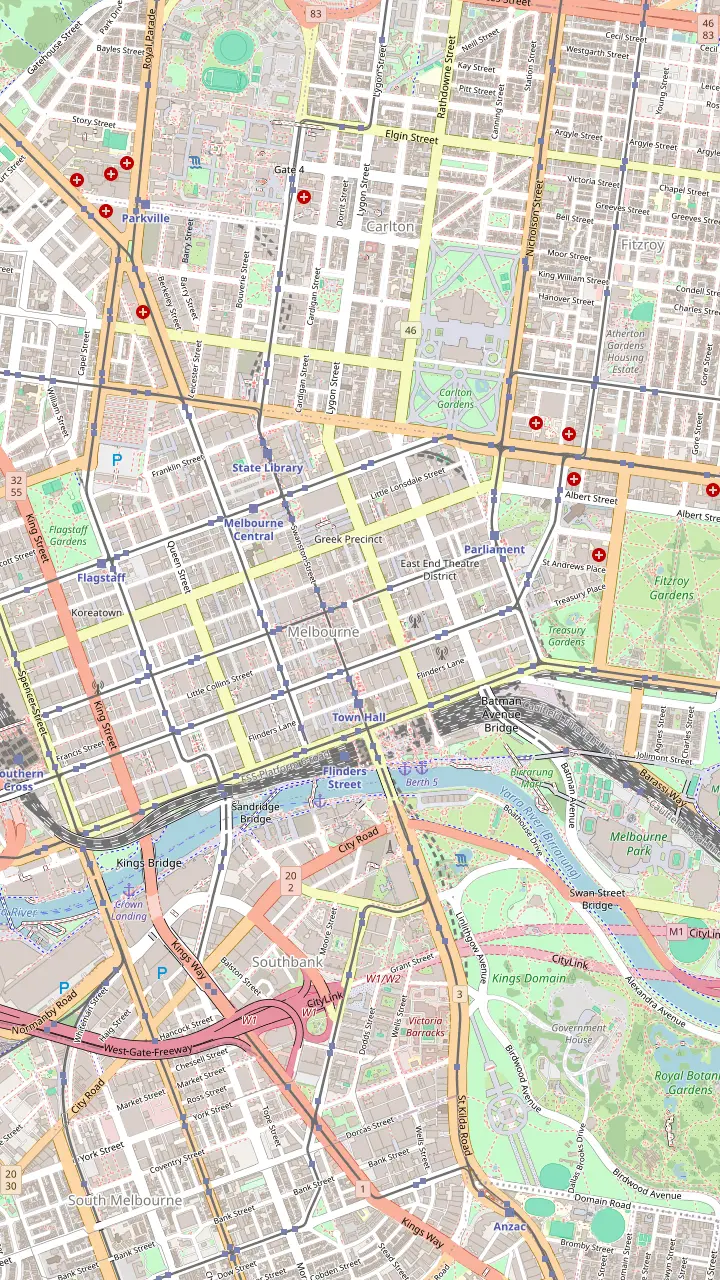
The small park opposite the Hotel Windsor where some of the afternoon bar walks begin.
Google MapsListed as the oldest building in Melbourne, in a lane off Collins Street.
Google MapsA hotel built in 1861, before the station across the road.
Google MapsAbove the lane, a feathered portrait by Adnate and Shida from 2012; the container bar Section 8 below.
Google MapsRobot Bar, full of vintage Japanese robot figures.
Google MapsFashion, cake and a basement bar under the lane.
Google MapsArlechin takes no bookings: walk in from 5pm, Tuesday to Saturday.
Google MapsStreet art below, a piano bar upstairs.
Google MapsLive music and a late licence on AC/DC Lane.
Google MapsA 1929 theatre and one of the best places in the country for a live band.
Google Maps© OpenStreetMap contributors, map data
The lanes and arcades of Melbourne are the city's covered short cuts and its Victorian showpieces. Here is what to look for in each, when they open, and where the chocolate is.
Editorial team, melbournelanewaystour.com · Updated November 8, 2026 · 7 min of reading
Quick look
The lanes and arcades of Melbourne grew out of a habit. In the 1880s the fashionable classes walked a set stretch of Collins Street between Swanston and Elizabeth streets to see and be seen, and they called it doing the Block.8,9 The State Library describes the young and stylish promenading both the footpaths and the arcades of Collins Street, in a city then in the middle of a land and property boom.9,10
Covered arcades suited that ritual perfectly. They let shoppers cross between the main streets through glass-roofed passages lined with small shops, out of the wind and rain, and they turned a back-of-block service lane into a parade. Several survive, and walking them in a chain is still the best way to cross the centre of the city on a wet day.
Collins Street itself was dressed for the part. Inspired by the boulevards of Paris, the city planted elms along it in 1875 and laid a woodblock pavement at the Swanston Street corner in 1881.11 The arcades that branched off it were built to the same ambition, and the best-known pair, the Block and the Royal, sit almost back to back between Collins Street and Bourke Street.
Arcade by arcade
| Arcade | Built | Look for | Links |
|---|---|---|---|
| Royal Arcade | 18691 | Gog and Magog28 | Bourke St to Little Collins St |
| Block Arcade | 189213 | Mosaic floor23 | Collins St to Elizabeth St |
| Centreway Arcade | 191115 | Edwardian Baroque front | Collins St to Flinders Lane |
| Cathedral Arcade | 192616 | Lead-light ceiling29 | Swanston St |
| The Capitol | 192430 | Griffin ceilings31 | Swanston St |
| Manchester Unity | 193217 | Mosaic arcade floor32 | Collins St and Swanston St |
Dates from the City of Melbourne and Heritage Victoria; the Royal Arcade's own site gives 1870.33
The Block Arcade at 282 Collins Street is the showpiece.19 It was developed by the financier Benjamin Fink, and Heritage Victoria records that its Collins Street section was finished in February 1892, with the Elizabeth Street wing completed in October 1893.13,20 The City's visitor pages give 1893 as its date, which matches that second stage.21 The architect was David Askew of Twentyman and Askew.22
Look down first. The floor is a patterned mosaic of tiles imported from Europe, and when it was laid a building journal of the day reported it as the largest area of mosaic yet laid in Australia.3,23 Then look up at the glass domed roof and stained glass, all modelled on the Galleria Vittorio in Milan.2 The arcade is L-shaped with a kink in the middle, and Heritage Victoria traces that bend to the old subdivision and to Block Place, the lane behind it.24
Small details reward a slow walk. One of the Collins Street shops housed the first Kodak shop in Melbourne.25 Classical musicians often busk at the entrance, and Haigh's Chocolates has a shop inside.26,6 Guided walks of the arcade itself are available.27 It opens 8am to 6pm Monday to Thursday, to 8pm on Friday, 8am to 5pm on Saturday and 9am to 5pm on Sunday.4
Walk north through Block Place and Little Collins Street and you reach the Royal Arcade at 335 Bourke Street.35 The City calls it the oldest surviving arcade in Australia, built in 1869.1 The arcade's own website says it opened in 1870, so you will see both years.33 It was designed by Charles Webb, who won the job in a design competition, and it began with 29 shops.12,36
The arcade's stars are a pair of giant figures. Gog and Magog, sculpted by Mortimer Godfrey after the effigies in London's Guildhall, were installed in 1892 beside Gaunt's clock.14 According to the City they have struck the hours since 1892, and you can still hear them.28 Stand under the clock just before the hour and watch them move.
Heritage Victoria counts the Royal Arcade among about 18 surviving arcades built before 1870 anywhere in the world.37 It has had a busy life: shop 27 once held Turkish baths, and rat tunnels wrecked the original floor, which was replaced in 1934.38,39 Today it links Bourke Street Mall, Little Collins Street and Elizabeth Street under one roof, and sells gifts, jewellery, Russian dolls and even magic spells.40,41
Pick your arcade walk
Find your arcade mood below.
If I love Victorian architecture
Block then Royal
If I want chocolate
Chocolate walk
A 3-hour tasting walk from the Block Arcade.
If I want local designers
Nicholas Building
A vertical laneway of studios and makers.34
If It is raining
The covered chain
Centreway, Block, Royal and The Strand keep you mostly dry.
If I want it all with a guide
Lanes and arcades tour
3 hours, up to 8 people, with tastings.
Three ways in
Group of up to 8
Most reviewed
Starts at the Block
Sweet tooth
Group of up to 10
Broader walk
Between Collins Street and Flinders Lane, the Centreway Arcade shows what came next. It was built in 1911 in the Edwardian Baroque style and ranks among the earliest commercial buildings in Melbourne framed entirely in steel.15 The National Trust record names H W and F B Tompkins as its architects.109 It is a handy covered link between Collins Street and Flinders Lane, lined with jewellery, book and fashion shops.69
A block east, at 37 Swanston Street, the Cathedral Arcade is the Art Deco entrance to the Nicholas Building.110,59 The building went up in 1926 to designs by Harry Norris, and the City calls it the grandest example of Chicago Style architecture in Melbourne.16 Its ground floor arcade has a vaulted, domed lead-light ceiling that is worth stopping under.29
Upstairs is the reason locals love it. The City describes the Nicholas Building as a vertical laneway, and its floors are full of galleries, studios, jewellers and small makers.34 Its first tenants came from the Flinders Lane rag trade, which is a neat link to the lane outside.48 Take the stairs or the old lifts and wander; many studios welcome browsers when their doors are open.
Price an arcade walk
Choose how many are going to compare starting totals.
Compare 4 alternatives
Choose how many are going to compare starting totals.
≈
View≈
View≈
View≈
ViewFrom-prices on GetYourGuide, shown at the ECB reference rate. Your exact price is confirmed during booking.
A century of arcades
1869
1875
The street is planted like a Paris boulevard.11
1892
The Collins Street section is finished; Gog and Magog arrive in the Royal Arcade.13,14
1911
An early all-steel-framed building in the city.15
1926
Chicago Style, with its own arcade and lead-light ceiling.16
1932
Along Swanston Street, between Collins and Bourke, two buildings carry the arcade idea into the age of cinema and Art Deco. The Capitol, a cinema built in 1924 in the Chicago Gothic style, has glowing ceilings by the architect couple Walter Burley Griffin and Marion Mahony Griffin.30,31 RMIT University bought it in 1999, and it is used for screenings and events.111
On the corner of Collins Street, the Manchester Unity Building of 1932 is Art Deco with a gothic tower, and it was the first building in Melbourne with escalators.17,18 Its ground floor arcade has a mosaic floor, marble walls and copper lift doors, and tours of the building are offered.32,112
Howey Place, off Little Collins Street, is a covered lane rather than a grand arcade, but it is the way into Presgrave Place and its tiny framed artworks.71 Further north, The Strand is a rainbow-lit modern arcade with a direct link into Emporium and the old GPO, which is useful if the weather turns.64,65
Video
Melbourne Walks on YouTube · The video stays unloaded until you press play.
Modelled on Galleria Vittorio in Milan, Italy, the arcade features an impressive glass domed roof, lavish decoration, stained glass windows and an extraordinary mosaic tile floor.
The arcades are also where the city's chocolate shops cluster. Haigh's Chocolates trades inside the Block Arcade, and in the Royal Arcade you can buy sweet treats at Koko Black.6,7 So it is no surprise that one chocolate walk starts at the Block Arcade, or that the lanes and arcades tour includes a tasting.
The Chocolate Wonderland walk starts outside the Block Arcade's Elizabeth Street doors and takes 3 hours, from $90. It is not wheelchair friendly, and dietary needs must be given when you book. A shorter guided chocolate walk of 2 hours meets where Flinders and Swanston streets cross, from $62, and its route includes some stairs and cobbled paths.
The Melbourne lanes and arcades tour booked on this page includes a chocolate tasting and coffee along the way, with an optional lunch and a glass of wine. It meets on the lower steps of Federation Square and keeps the group to 8. Its listing says all sales are final, so wait until your plans are settled before booking it.
The arcades open earlier than most shops. The Royal Arcade opens at 7am on weekdays, closing at 7pm, and at 8.30pm on Friday.5 The Block Arcade opens at 8am on weekdays.4 Many city shops keep 10am to 6pm hours, so the best time for the architecture is early morning, before the shops fill and the floors are crowded.113
Weekends are busy, particularly Saturday afternoon. If you want photographs of the mosaic floor or the glass roof, go early on a Sunday; the Block Arcade opens at 9am on Sundays and the Royal Arcade at 9am too.4,5 Keep to one side, as the arcades are working walkways, and ask before photographing inside individual shops.
The simplest route links them all. Start at the Centreway Arcade on Collins Street, cross to the Block Arcade, leave by Block Place, cross Little Collins Street and walk the Royal Arcade to Bourke Street. Add the Cathedral Arcade and Nicholas Building at the Flinders Lane end and the Manchester Unity Building on Swanston Street, and you have seen a century of Melbourne arcades in under an hour.
FAQ
8am to 6pm Monday to Thursday, 8am to 8pm Friday, 8am to 5pm Saturday, 9am to 5pm Sunday.4
The figures by Gaunt's clock in the Royal Arcade have struck the hours since 1892.28
A 3-hour walk meets at the Block Arcade and a 2-hour walk at Flinders and Swanston streets.
In the 1880s, walking Collins Street to be seen was called doing the Block.9
The Block and Royal arcades are level walkways, but some side lanes are cobbled; one chocolate walk is not wheelchair friendly.
Sources
Next read
Not sure which walk to book? Ask a real person here.