Plants and culture
Gardens walk
Most reviewed
- Length1.5 hours
- GroupUp to 25
- MeetsVisitor Centre
Guides
Language
Currency
Find open dates$90 and up · free cancelSpot your stop
Royal Botanic Gardens Melbourne: Aboriginal Heritage Walk
★ 4.8 · 423 written reviews
Summary
An Aboriginal walking tour in Melbourne means the First Peoples-led Aboriginal Heritage Walk at the Royal Botanic Gardens or the Koorie Heritage Trust's river walk from Federation Square.
Walk essentials
Open 54 stops
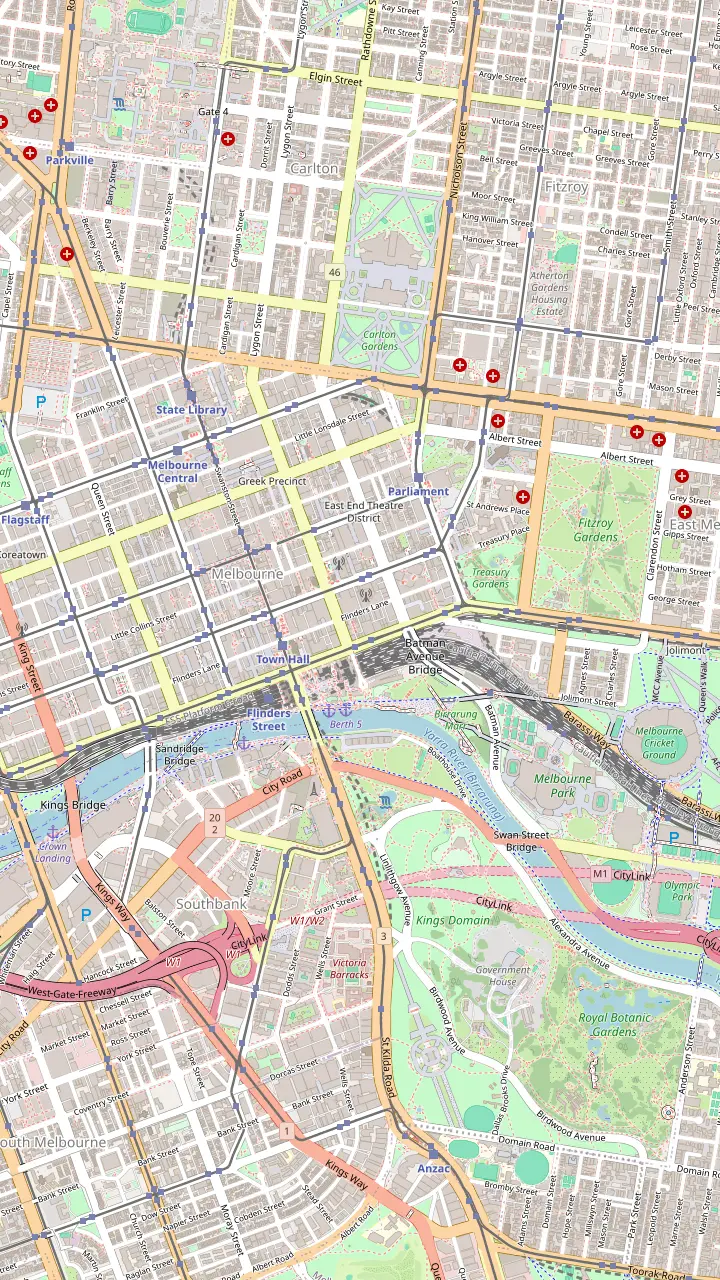
Tap a route first, then a pin or stop, for its note and Google Maps.
A First Peoples arts centre founded in 1985, open daily from 10am.
Google MapsThe river camp installation: an eel path, message sticks and ancestor stones by the river.
Google MapsNamed after a Wurundjeri elder; voices play as you walk across.
Google MapsWhere people gathered from the 1890s to the 1960s to hear Aboriginal speakers.
Google MapsA traditional Kulin meeting place; a paving inlay reproduces a William Barak painting.
Google MapsA 31-storey building whose balconies form a portrait of William Barak.
Google MapsIndigenous art from the NGV collection at Federation Square.
Google MapsMeet at the Visitor Centre for the First Peoples-led plant walk, 10:45am on Tuesday, Wednesday, Thursday, Saturday and Sunday.
Google MapsBunjilaka, the place of Bunjil, inside Melbourne Museum.
Google Maps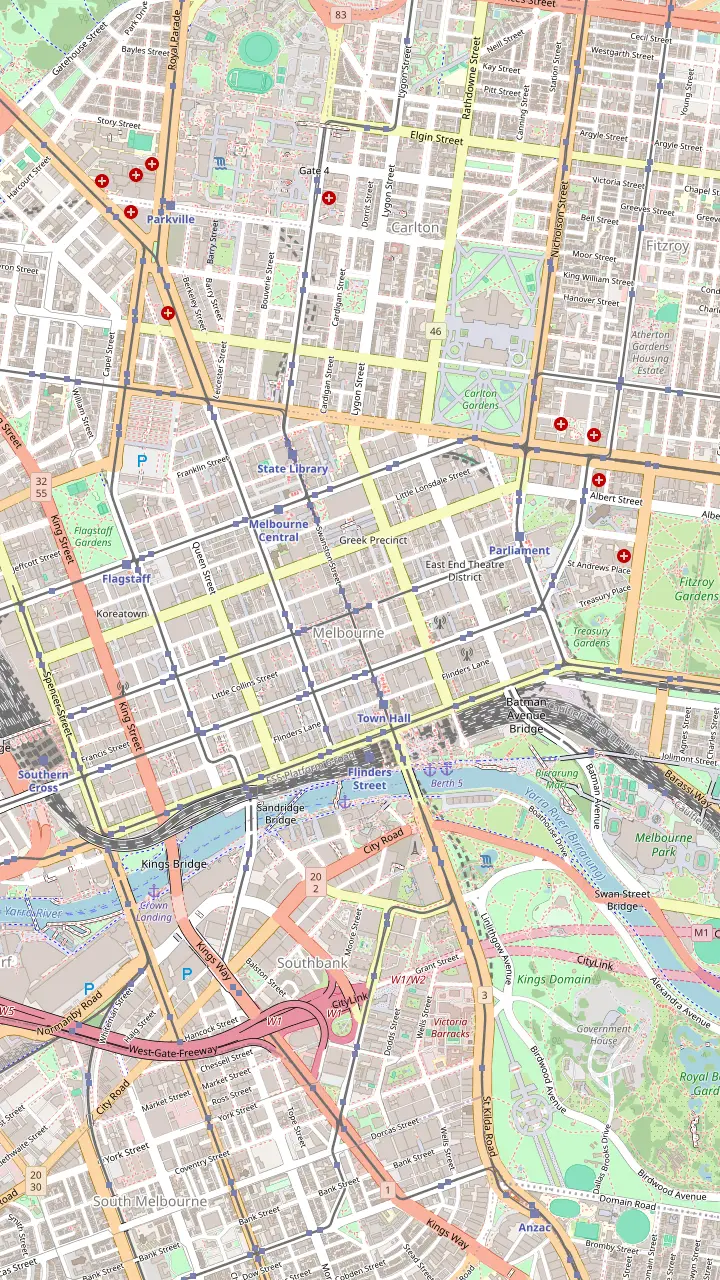
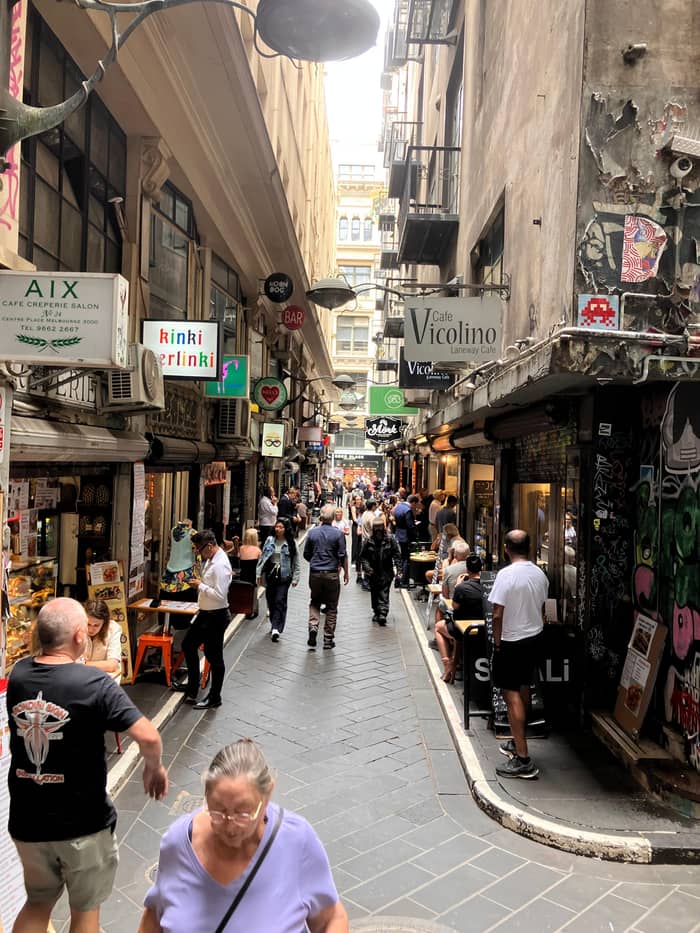
Opposite Flinders Street Station: brunch tables down the middle of the lane, street art, and small shops such as a Florentine stationer.
Google MapsA narrow, crowded alley of cafes and bars; note the Spanish Moorish Majorca Building on the corner, from 1928.
Google MapsThe lane behind the Block Arcade; its line is the reason the arcade bends.
Google MapsNamed after the fabric factories of the 1860s, now small designer and shoe shops.
Google MapsThe old rag-trade lane, with the Nicholas Building at its Swanston Street end.
Google MapsThe city's best-known street art lane, repainted so often that pieces vanish overnight.
Google MapsAustralia's first street named after a rock band, with a lightning bolt instead of the slash.
Google MapsHome of the bar that started the laneway revival, with Mike Makatron's Jungle Funk mural at the entry.
Google MapsA long lane of outdoor tables and live music; Kirk's recalls its 1840s horse trading.
Google MapsA rare survivor of the industrial city, now green with plants and cafes.
Google Maps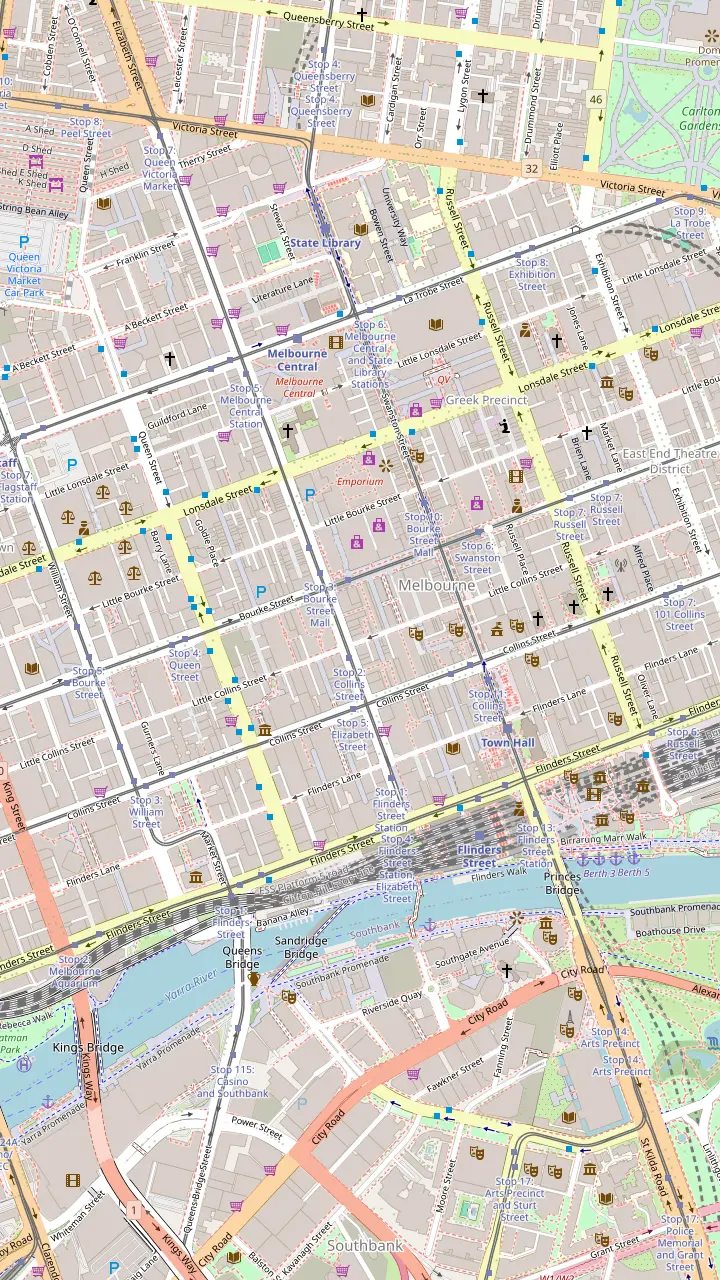
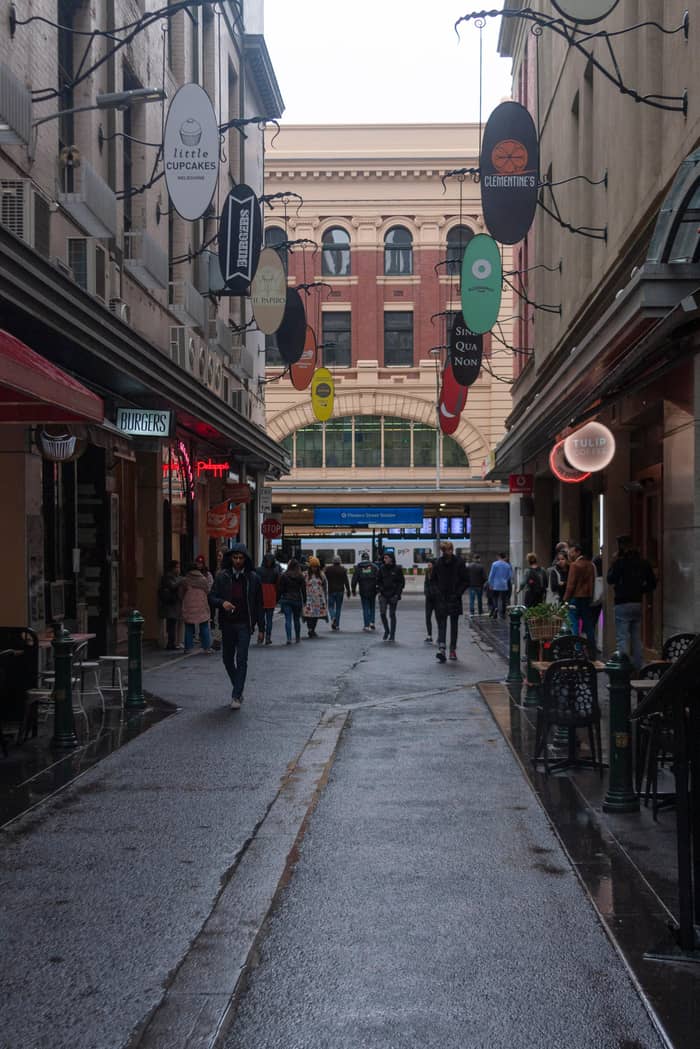
Opposite Flinders Street Station: brunch tables down the middle of the lane, street art, and small shops such as a Florentine stationer.
Google MapsA narrow, crowded alley of cafes and bars; note the Spanish Moorish Majorca Building on the corner, from 1928.
Google MapsCrepes and banh mi, and a look up at Bible House of 1898.
Google MapsAn Art Deco arcade that opens into the Nicholas Building of 1926.
Google MapsNamed after the fabric factories of the 1860s, now small designer and shoe shops.
Google MapsGlass roof and a mosaic floor laid with tiles from Europe; the Collins Street side was finished in February 1892.
Google MapsAustralia's oldest surviving arcade, built in 1869; Gog and Magog have struck the hours since 1892.
Google MapsA long lane of outdoor tables and live music; Kirk's recalls its 1840s horse trading.
Google MapsStreet art below, a piano bar upstairs.
Google MapsA double-storey shipping container bar with a rooftop.
Google MapsArtist Mirka Mora once worked here; today the balconies spill greenery.
Google MapsCoffee roasters and a shop for shoes, haircuts and suits.
Google MapsA rainbow-lit arcade with a direct way into Emporium and the GPO.
Google MapsFashion, cake and a basement bar under the lane.
Google MapsA green wall leads to a lantern-lit pizzeria; Emporium's floors of shops are at the far end.
Google Maps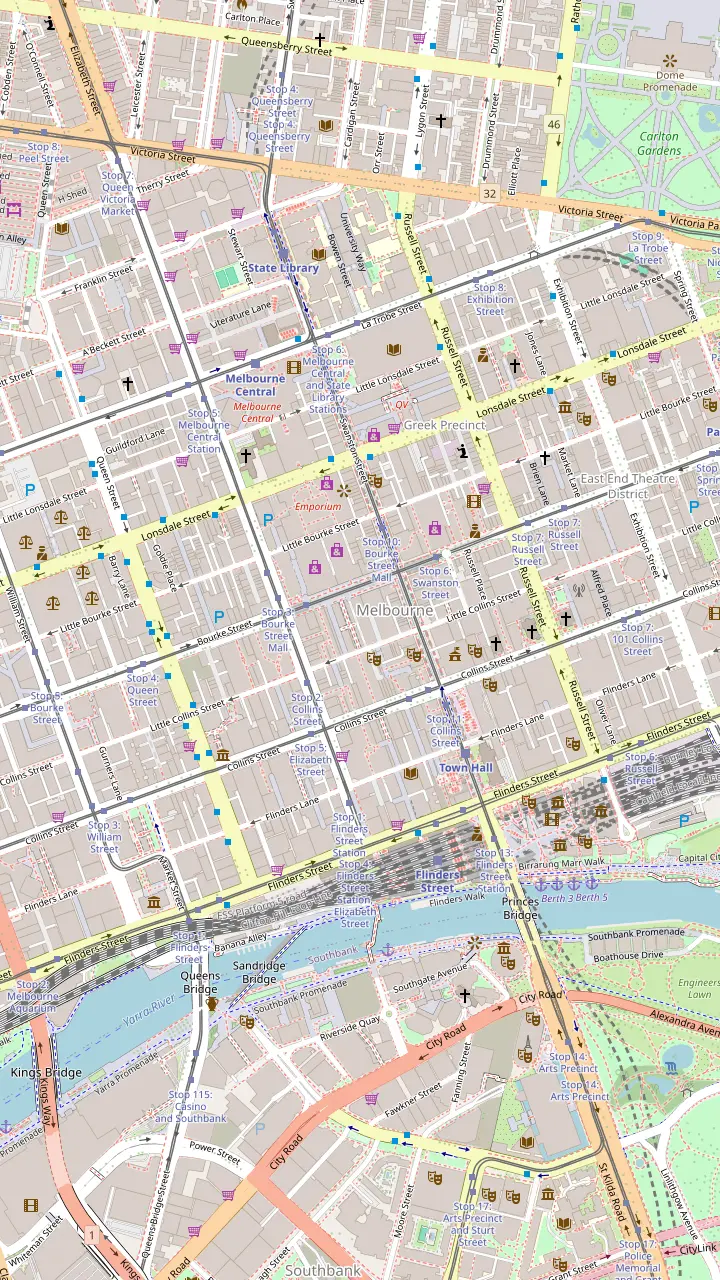
Glass roof and a mosaic floor laid with tiles from Europe; the Collins Street side was finished in February 1892.
Google MapsAustralia's oldest surviving arcade, built in 1869; Gog and Magog have struck the hours since 1892.
Google MapsEdwardian Baroque of 1911 linking Collins Street and Flinders Lane.
Google MapsAn Art Deco arcade that opens into the Nicholas Building of 1926.
Google MapsA 1924 cinema with lit ceilings by Walter Burley Griffin and Marion Mahony Griffin.
Google MapsArt Deco of 1932 and Melbourne's first building with escalators; mosaic arcade at street level.
Google MapsThe lane that leads to Presgrave Place, with a tiny vegan jaffle kiosk.
Google MapsA rainbow-lit arcade with a direct way into Emporium and the GPO.
Google MapsThe lane behind the Block Arcade; its line is the reason the arcade bends.
Google Maps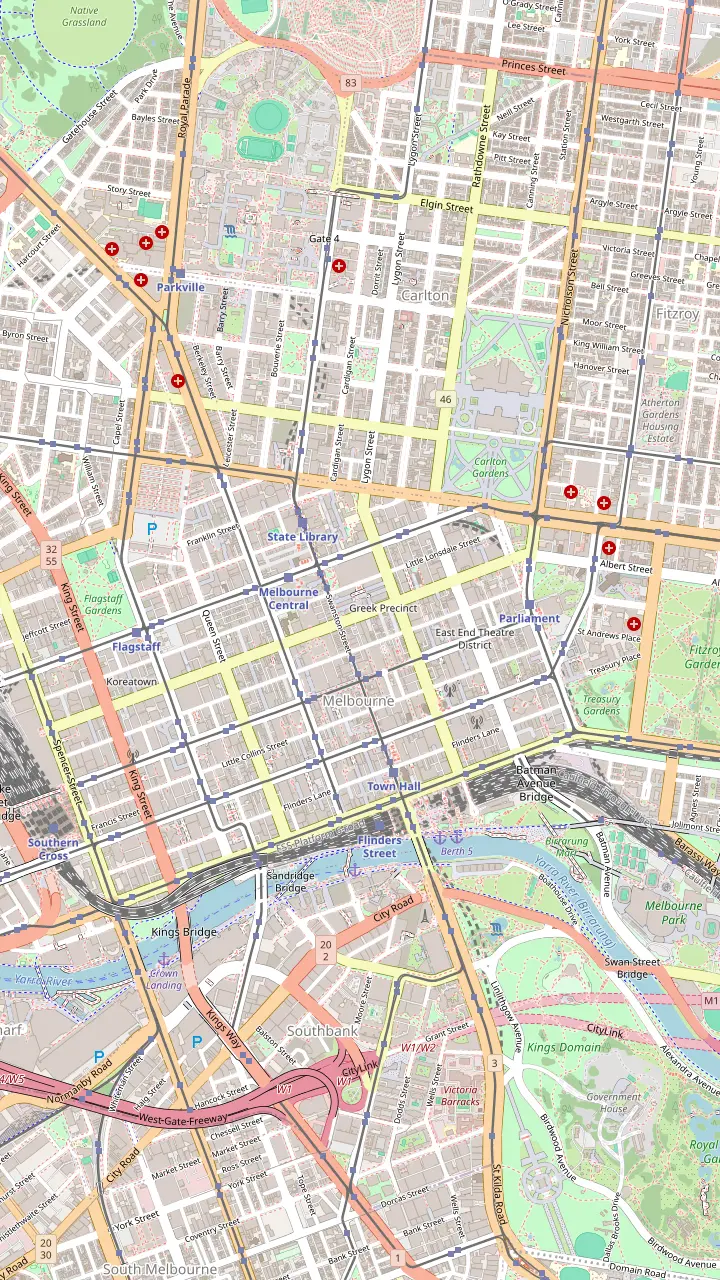
The city's best-known street art lane, repainted so often that pieces vanish overnight.
Google MapsOff Hosier Lane; even the bins here are painted over.
Google MapsAustralia's first street named after a rock band, with a lightning bolt instead of the slash.
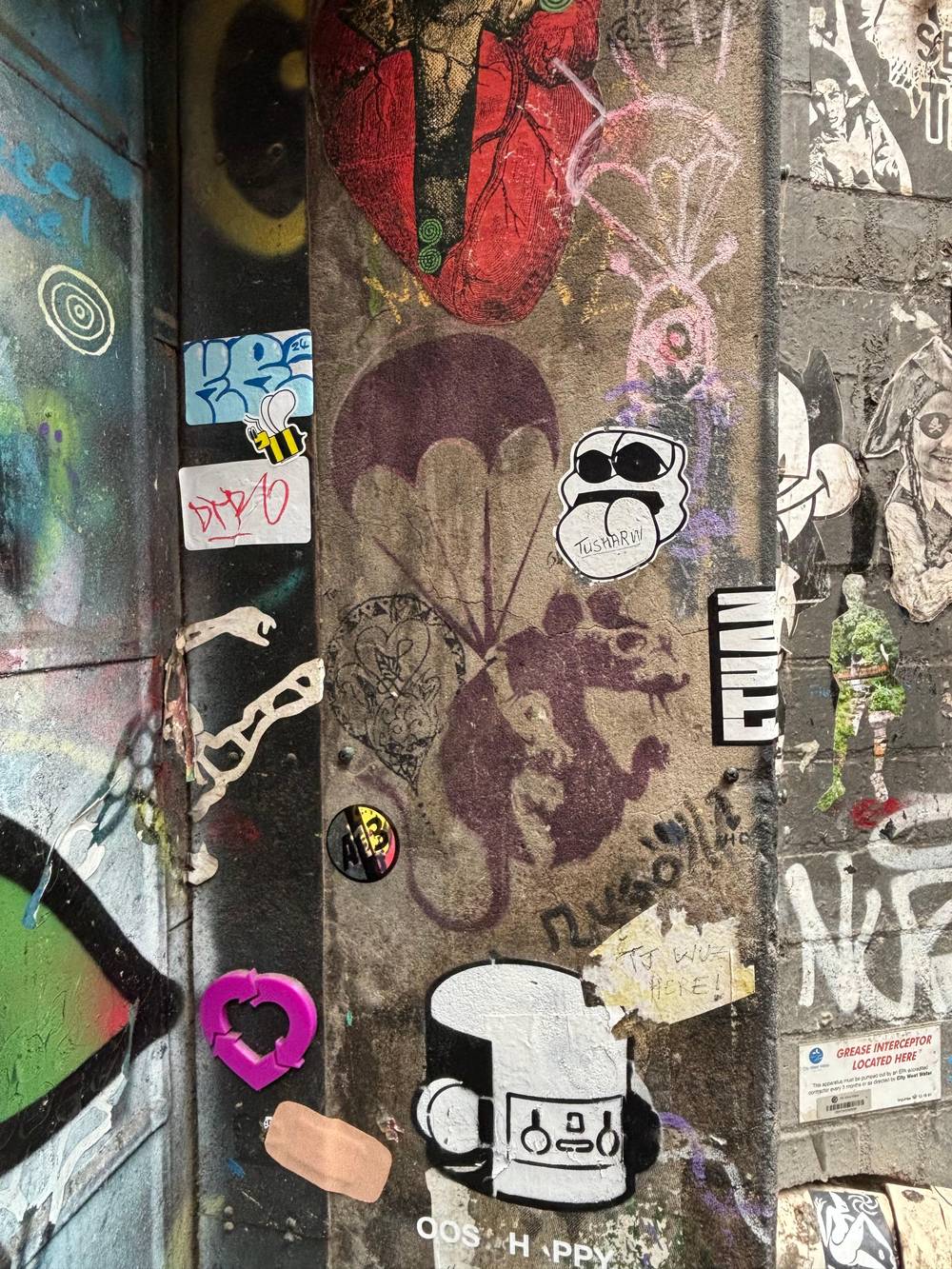
Google MapsBig murals by Fintan Magee and Steen Jones, and one of the last Banksy rats.
Google MapsLisa King's giant sleeping woman on the wall of Brunetti.
Google MapsA miniature outdoor gallery of framed works on the walls.
Google MapsAbove the lane, a feathered portrait by Adnate and Shida from 2012; the container bar Section 8 below.
Google MapsA winding lane off Little Bourke Street with colourful murals.
Google MapsA tiled mosaic for Legacy House and a towering mural by Jaz Mishap at the end of the alley.
Google MapsNamed after Blender Studios, an early home of the city's street art scene, off Franklin Street.
Google MapsHome of the bar that started the laneway revival, with Mike Makatron's Jungle Funk mural at the entry.
Google Maps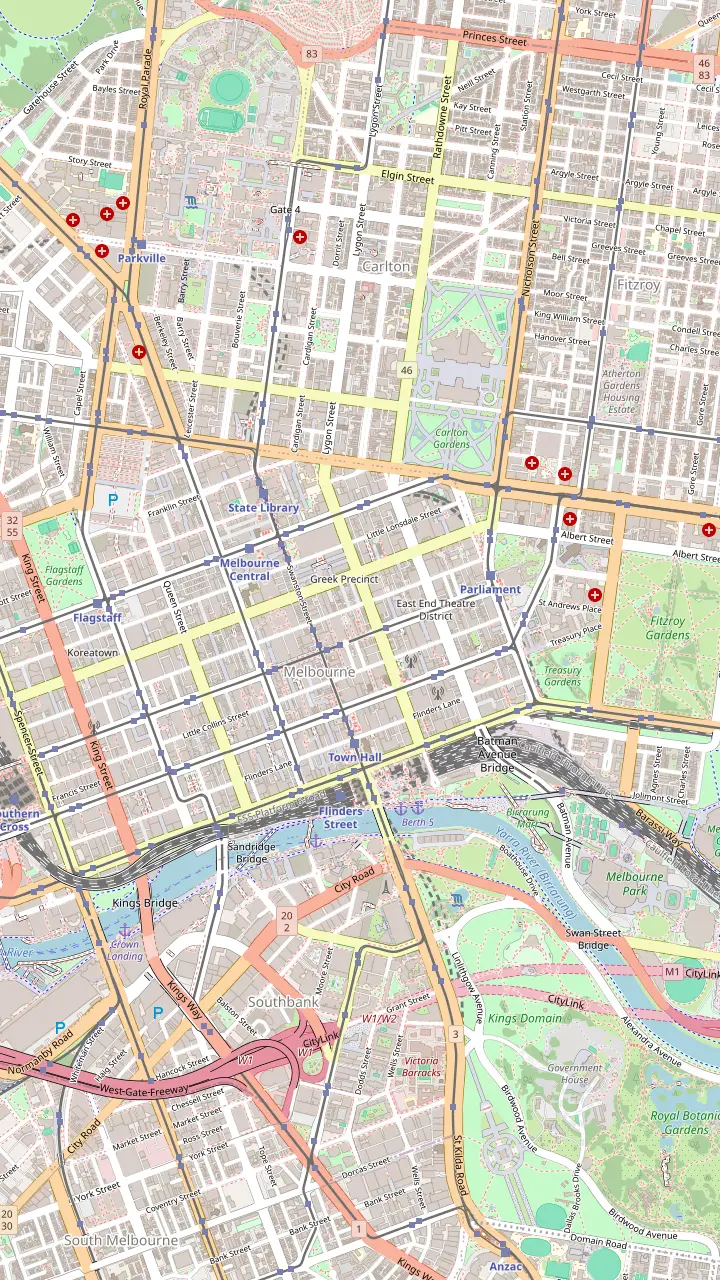
Australia's oldest train station site; the present building was completed in 1910. Meet under the clocks.
Google MapsA hotel built in 1861, before the station across the road.
Google MapsCompleted in 1870 in bluestone and Tasmanian freestone; free tours are offered.
Google MapsAustralia's oldest surviving arcade, built in 1869; Gog and Magog have struck the hours since 1892.
Google MapsGlass roof and a mosaic floor laid with tiles from Europe; the Collins Street side was finished in February 1892.
Google MapsListed as the oldest building in Melbourne, in a lane off Collins Street.
Google MapsOpened in 1854; Ned Kelly's armour is on display.
Google MapsMelbourne's prison from 1845, run today by the National Trust.
Google MapsIts exhibition traces how the city boomed after the 1850s gold finds.
Google MapsArt Deco of 1932 and Melbourne's first building with escalators; mosaic arcade at street level.
Google Maps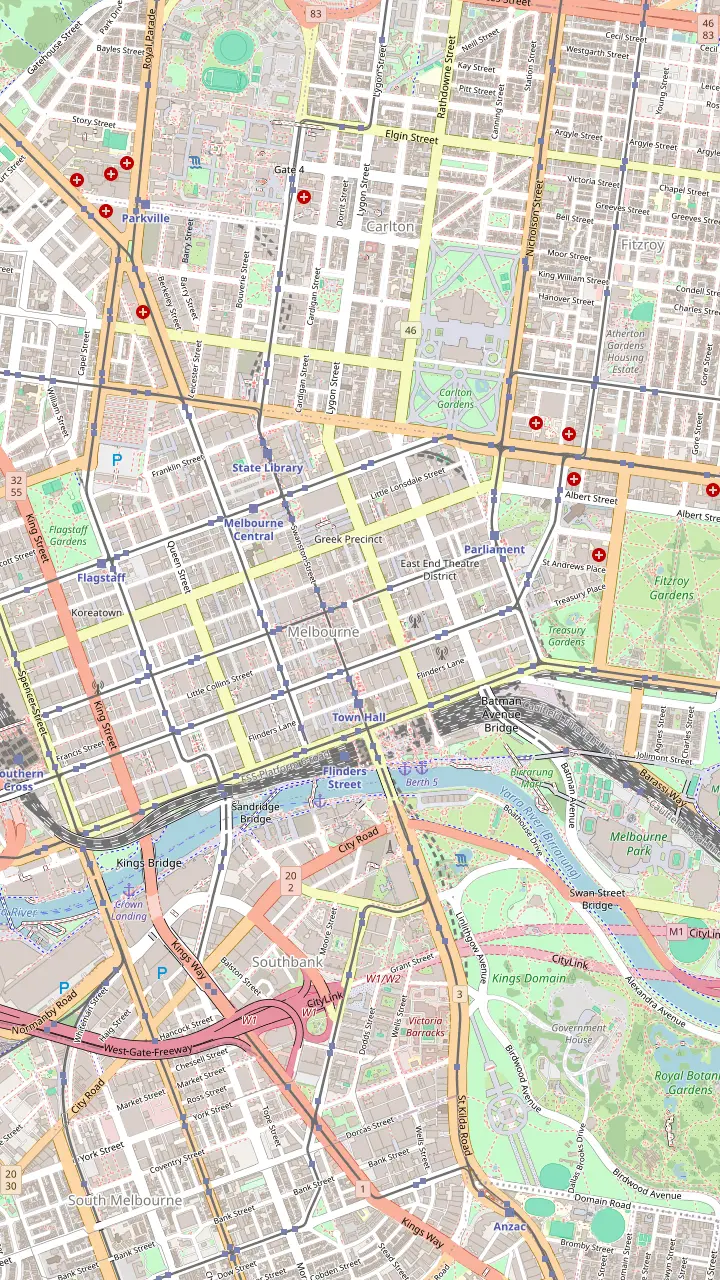
The small park opposite the Hotel Windsor where some of the afternoon bar walks begin.
Google MapsListed as the oldest building in Melbourne, in a lane off Collins Street.
Google MapsA hotel built in 1861, before the station across the road.
Google MapsAbove the lane, a feathered portrait by Adnate and Shida from 2012; the container bar Section 8 below.
Google MapsRobot Bar, full of vintage Japanese robot figures.
Google MapsFashion, cake and a basement bar under the lane.
Google MapsArlechin takes no bookings: walk in from 5pm, Tuesday to Saturday.
Google MapsStreet art below, a piano bar upstairs.
Google MapsLive music and a late licence on AC/DC Lane.
Google MapsA 1929 theatre and one of the best places in the country for a live band.
Google Maps© OpenStreetMap contributors, map data
An Aboriginal walking tour in Melbourne shows a city that stands on Wurundjeri and Kulin Country. Here are the First Peoples-led walks, the places by the river, and how to visit with respect.
Editorial team, melbournelanewaystour.com · Updated November 8, 2026 · 7 min of reading
Quick look
An Aboriginal walking tour in Melbourne begins with whose land you are on. The City of Melbourne explains that the Eastern Kulin brings together 5 Traditional Owner groups, namely the Wurundjeri, Bunurong, Dja Wurrung, Taungurung and Wadawurrung peoples.5 Their Country reaches around Port Phillip and Western Port and up to the Great Dividing Range, and the groups share a creator, Bunjil.6,7
The central city's traditional name is Narrm, and Melbourne stands on ancient Wurundjeri land within the Kulin Nation.8,9 The City's acknowledgement speaks of a connection to this place maintained for more than 2000 generations.10 You will hear the welcome womindjeka, or wominjeka, at many cultural sites; it means welcome in the languages of the Traditional Owners.4
A First Nations walking tour in Melbourne is the best way to hear this history from the people it belongs to. Guides choose what to share, and some knowledge is not for visitors at all, which is exactly as it should be. What follows covers the walks led by First Peoples guides, the public places you can visit on your own, and the simple courtesies that make a visit go well.
Side by side
| Experience | Where | When | Led by |
|---|---|---|---|
| Aboriginal Heritage Walk | Royal Botanic Gardens | 10:45am, set days1 | First Peoples guide25 |
| Birrarung Wilam walk | Koorie Heritage Trust | From 1pm2 | Koorie guide26 |
| Koorie Heritage Trust | Federation Square | 10am to 5pm daily11 | First Peoples centre27 |
| Bunjilaka | Melbourne Museum | Daily, with exceptions28 | Planned with Traditional Owners29 |
| Aboriginal Melbourne walk | Across the city | Any time | Self-guided3 |
Times and days as the venues and the City of Melbourne publish them; check before you go.30
The heart of Aboriginal Melbourne is the river. Birrarung Marr is the park on the north bank of the Yarra beside Federation Square, opened in 2002.16 In the Woi Wurrung language, birrarung means river of mists; the City's walk says marr relates to the edge, and its park page says side.17,18 Either way, it names the land beside the river of mists.
Inside the park is Birrarung Wilam, a phrase meaning river camp.19 The installation centres on a mound campsite, an eel path, message sticks and a cluster of ancestor stones.20 A semicircle of metal shields stands for the 5 groups of the Kulin Nation, and the winding path recalls the eel as a traditional food.21 Nearby, an Eel Trap sculpture recalls that eels were once plentiful here.22
Eel traps were set by shallow waterfalls that once separated the river's fresh water from the salt water of the bay.23 That natural fall was blown up in 1883.24 From Birrarung Wilam, the William Barak Bridge, named after a Wurundjeri elder, carries a soundscape of Wurundjeri voices that changes as you cross.13
A day on Kulin Country
10am
The centre opens at Federation Square.11
10:45am
Meet at the Botanic Gardens Visitor Centre.1
Midday
Indigenous art from the NGV collection.12
1pm
The Trust's guided walk to the river.2
Afternoon
Hear Wurundjeri voices as you cross.13
Late afternoon
The Koorie Heritage Trust is a First Peoples arts and cultural centre at Federation Square, founded in 1985 and open from 10am to 5pm every day.27,11 Its building is designed to connect you to Country: the red reflects the landscape, the columns reimagine the scar tree and the rippled ceiling echoes moving water.33 Stairs, an escalator and a lift reach all 3 levels.34
Its Birrarung Wilam walk leads from Federation Square down to the art installations by the river, with a Koorie guide explaining how the land under the city has changed.26 Fed Square lists it on weekdays, except public holidays, from 1pm, at AUD 40 for adults and AUD 20 for students and concession.2 Tourism Australia describes it as running at 1pm each day, so check the current days when you book.35
On the Trust's cultural walks you may hold replica objects, among them a cloak of possum skin, clap sticks and a spear-thrower, as the guide explains what each one meant.36 The river walk is wheelchair accessible; tell your guide if you need a ramp rather than stairs.37 Walk-up tickets are sold at the Trust's front desk too, while places last.38
Choose your walk
Pick the line that fits your day.
If I want to learn about native plants
Gardens walk
Taste, touch and smell with a First Peoples guide.31
If I want the river and the city's story
Birrarung Wilam walk
From Federation Square to the river installations.26
If I am travelling with children
Bunjilaka
A museum centre with Bunjil's nest, a garden trail and the languages of Victoria.14,15,32
If I have no budget
The City's free walk
A self-guided route of significant sites.3
If I want art
Koorie Heritage Trust and NGV
Three ways to go
Plants and culture
Most reviewed
Starts 1pm
Meets at the Trust
Free
City walk
The Royal Botanic Gardens describe Melbourne Gardens as a significant cultural site for the Kulin Nation, and their Aboriginal Heritage Walk is led by a First Peoples guide.25 It is a walk through plants rather than buildings: your guide may ask you to taste, touch and smell as you learn how plants were used and what they mean.31 It is also wheelchair accessible.111
The official details are clear. You meet at the Visitor Centre, the walk lasts 1.5 hrs, and sessions run at 10:45am on Tuesday, Wednesday, Thursday, Saturday and Sunday, with no sessions on Christmas Day or New Year's Day.1 The Gardens list AUD 55 for adults and AUD 40 concession, bookings are essential, and a 10% surcharge applies on public holidays.110 Because of works, tours leave from Oak Lawn from 26 October 2026, but you still check in at the Visitor Centre.30
There are no child tickets: children are welcome, but the walk is designed for older audiences and under-15s book at the concession rate.112 The listing booked on this page is this Gardens walk, in English, for up to 25 people, from $38 with free cancellation up to 24 hours ahead. As an Indigenous walking tour in Melbourne, it suits anyone curious about food, medicine and the plants that the city grew over.
Price your walk
Choose how many are joining to see starting totals.
Compare 2 alternatives
Choose how many are joining to see starting totals.
≈
View≈
ViewFrom-prices on GetYourGuide, shown at the ECB reference rate. Your exact price is confirmed during booking.
The City publishes a free Aboriginal Melbourne walk that you can download.3 At Parliament House, a granite and brass paving inlay reproduces a painting by William Barak from about 1880; the work, called Ceremony, marks the site as a ceremonial ground and meeting place of the Kulin Nation.103,113 In Parliament Gardens, Ngarra Murray etched emu and crow totems into the bluestone at the memorial to Pastor Sir Doug and Lady Gladys Nicholls.114
On Swanston Street, the balconies of a 31-storey building form a portrait of William Barak.104 Barak was a respected Wurundjeri leader who spoke up for his people and witnessed the John Batman treaty.115 By the river, Speakers Corner marks where communities gathered from the 1890s to the 1960s to hear Aboriginal thinkers such as Bill Onus and Gary Foley.101
Further out, scarred trees still stand in Yarra Park, where the Eastern Kulin played marngrook, an early form of football.116,117 In the Botanic Gardens, the ornamental lake keeps part of Tromgin Billabong, once an eel fishing place.118 An artwork also remembers 2 Aboriginal men publicly hanged in Melbourne in 1842.119 The City's online map shows many more places of Aboriginal significance.120
Video
Australia on YouTube · The video stays unloaded until you press play.
The groups are spiritually, culturally, politically and economically connected with a shared creator, Bunjil.
Walk checklist
For a longer visit, Bunjilaka at Melbourne Museum is the place. Its name means the place of Bunjil, and it was planned together with Aboriginal people including the Boonwurrung and Woi wurrung.105,29 Inside you can hear the 38 distinct languages of Victoria, enter Bunjil's nest in the First Peoples exhibition, and walk the Milarri Garden Trail of indigenous plants.32,14,15
Bunjilaka opens daily except Good Friday and Christmas Day.28 It sits in Carlton, a short tram ride north of the lanes, so it pairs well with a morning at the Koorie Heritage Trust and an afternoon in the city.
At Federation Square, the Ian Potter Centre: NGV Australia shows Indigenous art from the national gallery's collection, including works by Emily Kam Kngwarray and Rover Thomas alongside contemporary artists such as Brook Andrew and Destiny Deacon.12 It is next door to the Koorie Heritage Trust, so a walk, the Trust's exhibitions and the gallery fit comfortably into a single day.
The Royal Botanic Gardens put it well: they invite walkers to come with an open heart and mind and to learn about living culture, not just history.121 That is the right spirit for every visit. Ask questions, listen to the answer you are given, and accept that some things are not shared.
Treat installations such as Birrarung Wilam as places, not props. Sit where seating is offered, walk the paths, and do not climb on or move the stones and shields. Ask before you photograph a guide or a person taking part in a ceremony, and follow any request not to film. If you buy art or objects, buy from Aboriginal-run outlets such as the Koorie Heritage Trust's shop.
Finally, remember that there are many First Peoples. The Gardens acknowledge Aboriginal and Torres Strait Islander peoples of more than 250 language groups across Australia, and the culture you meet in Melbourne is that of the Kulin Nation, not a single national culture.122 Using local names, such as Narrm and Birrarung, is a small way to show you were listening.8
FAQ
It runs 1.5 hrs from the Visitor Centre at 10:45am on set days.1
Fed Square lists AUD 40 for adults and AUD 20 for students and concession.2
There are no child tickets; under-15s book at the concession rate.112
In Woi Wurrung, birrarung means river of mists.17
The City's Aboriginal Melbourne walk is free to download and follow.3
Sources
Next read
Not sure which walk to book? Ask a real person here.